
Perplexingly Merry
On hope as a group project in an age of anxious screens and the unlikely hero in The Magician's Nephew

Welcome to The Just Beautiful Newsletter where I write about making space for beauty and justice to meet. Due to my husband’s sudden death last year, and a baby, I can’t promise or predict what these essays will be! But they tend to wander in the direction of finding beauty and hope in the midst of grief and injustice … and usually in children’s books. Thank you for being here.
Last year, about this time, my neighbour and I were finalizing the programme for Minimoot, a gathering of local Christians who like to think about art and faith (ala Rabbit Room, if that means anything to you). This was our fourth gathering and while there was the inevitable stress of how many people are actually coming?? and Will we have enough tea?! there was also a delight in the bustle and buzz of bringing people together around a meaningful question. Our theme last year was taken from Wendell Berry’s poem: “Be joyful… though you have considered all the facts.” Local theologians, educators, visual artists, pastors and writers examined what it meant to make art in a fallen world. How were we as Christians uniquely called to be, in the words of novelist Lief Enger, “Probably doomed and perplexingly merry” ?
As I sit in my own waves of grief at the loss of my husband, while watching waves of immigration agents overrun my extended family’s neighbourhoods in Minnesota on the news, the probably doomed bit seems rather clear.
Author Jemar Tisby said this week that Hope is a group project1. We’ve all been part of group projects that were endless email chains resulting in someone redoing everyone’s slides at 2am because no one else read the requirements properly. If hope is a group project, maybe we’re failing?
My book club is reading The Anxious Generation (yes, I know you all read it last year, but I had some stuff happening, alright) and I just read the section on the research around online activism. Historically, when looking at people who were engaged in political or social activism, researchers found higher levels of wellbeing. Today, although young people are more concerned about social issues than ever before, and are very engaged online about it, they aren’t showing any of the mental wellness benefits that previous generations of activists reported.
Practical things like phone numbers for senators, videos and facts about real events, payment portals to make donations — these all live in our screens and are essential to pushing the needle towards justice. But disembodied activism seems to be high on angst and righteous indignation, and low on hope.
In the Magician’s Nephew by C.S. Lewis, the children, their evil uncle, an even more evil witch, and a London cabby all end up in a brand new world. They are completely thrust out of everything they know and thrown into complete darkness. Not used to this sort of thing, it’s frankly terrifying.
“It was so dark they couldn’t see one another at all and it made no difference whether you kept your eyes shut or open…
“My doom has come upon me,” said the Witch in a voice of horrible calmness.
“Oh don’t say that,” babbled Uncle Andrew… “You don’t happen to have a flask about you? A drop of spirits is just what I need2.”
“Now then everyone,” came the cabby’s voice, a good, firm, hardy voice. “Keep cool everyone, that’s what I say…”
[The Cabby at first suggests they’ve fallen into some diggings for the London Underground, but concedes they may have died].
“… you got to remember, worse things happen at sea and a chap’s got to die sometime. And there ain’t nothing to be afraid of if a chap’s led a decent life. And if you ask me, I think the best we could do to pass the time would be to sing a ‘ymn.”
And he did. He struck up at once a harvest thanksgiving hymn, all about crops being safely gathered in. It was not very suitable to a place that felt as if nothing had ever grown there since the beginning of time, but it was the one he could remember best. He had a fine voice, and the children joined in; it was very cheering.”
The crisis just reveals what’s already there.
The Witch and Uncle Andrew are doomed. They know they are doomed.
But, even in this completely disorienting situation, thanks to the Cabby (who turns out to be a king in the end), the children sing an unsuitable hymn and feel a whole lot better3.
When it comes to the group project, the Cabby’s someone who is probably not really shining in the email chain, doesn’t know how to fix his auto-correct, forgets to attach his slides. But his ability to contribute to hope came from the fact he was there.
Being there, in real life, as a neighbour helps. Listening to a real person ramble on and then striking up a hymn and then really singing it at the top of your lungs— helps. It’s not that co-ordinating and administrating action online isn’t activism, or isn’t important. It is. But maybe there’s something important in the being there, too, something that allows for our strange, quirky,humanness to encounter each other.
Maybe your only experiences of group projects are lame.
But maybe, like me, you’ve been lucky enough to work with your neighbour to spend an afternoon setting up tables and freaking out about having enough chairs and snacks, and then the next day ended up with sixty people talking about faith and art and making new connections with each other.
Maybe you’ve sat in one of those side rooms off of a sanctuary in a church that was trying not to look too churchy and heard person after person share their story of grief, and person after person encircle them, and hand them a tissue, and say they’ve felt exactly the same thing. And the awkwardly trite phrase doesn’t sound so trite when you can see the face of the person it’s coming from, and the tears streaming down their face.
Maybe you’ve sung in a choir.
Maybe you’ve been in a Bible study that made you crabby and exhausted every week while you were cleaning your kitchen beforehand, and yet once you were squished tightly on a sofa, straining to hear the explanatory video on someone’s crappy phone speakers because the power was out again, you found there was no other way you’d like to spend your Tuesday night.
Maybe you’ve flown and driven hours across the country to meet up with your family members to go to a political march, and been surrounded by thousands and thousands of people, all chanting the same chants for change, and found they are not professional activists but a thousand tourist strangers all helping each other with which subway stop is next, and how to get the stroller up the stairs, and where the closest bathroom is.
Maybe you’ve organised a hygiene pantry, or taught English, or brought groceries.
Maybe, in the flat of the screens, all alone, while we hammer away at the tasks, the darkness is too stark. The evil is too great. The odds are too poor. When we look at just the facts, we’re probably doomed.
Maybe it’s only when we’re together that we remember the Spirit of God still lives and moves and has his being in us, that we believe in the miraculous, that prayer is not just talking to ourselves. Maybe there’s a reason the apostle Paul told the persecuted church not to neglect meeting together.
Maybe it’s the people with us that keep our sense of humour for us when we’ve lost our own.
Maybe hope is a group project.
Review Giveaway!
Thanks to everyone who left a review of my annotated edition of Little Women this December! We finally hit the 10 review threshold! So I’m doing the lucky draw tomorrow- you still have time to leave a review if you want to enter! Reviews are one of the biggest ways you can help authors (besides pre-ordering their book, or buying it, or telling a friend in real life to buy it), so thank you!
Just Beautiful Links:
A round up of things I’m reading and listening to and thinking about as they relate to justice, beauty, and children’s literature!
📘 I counted, and realised that last year we read aloud over 50 books (45 if you don’t count shorter series), and this doesn’t include audio books. If we didn’t hit hardly any of our homeschool goals last year, it’s okay. With all the changes our family has been through, reading together was a raft that helped carry us through! Also, the boys are 6 and 8 now and this really is the golden age for reading aloud- SO many more books are no longer “too scary” and the books are interesting for me, too!
📚 Current Kid Reads: We finished the Chronicles of Narnia again (Still Amazing 4th time through), and plunged deeper into the Swallows and Amazon’s series. We’ve read some Enid Blyton, too (The Secret Island, which has Boxcar children vibes). I don’t really love Enid Blyton for read alouds, she’s a bit tedious and trite - but this was a book I stopped reading and my hesitant reader picked up to read for himself, so that was a win. On the other end of the spectrum we’ve been reading lots of Edith Nesbit’s books (I love that she gets a shout-out at the beginning of Magician’s Nephew, and honestly, reading her books makes me realise her way of depicting children’s conversations probably very much influenced Lewis’s style). Her sentences sometimes trip me up, they are so convoluted, and we are learning words like “accouterments” and “piffle”, but the kids are now quite attached to the Bastables, and have enjoyed The Pheonix and the Carpet and The Five Children and It. Then kids get the humour, and they are funny enough to make even me laugh out loud.
📘 Due to a variety of book clubs, I’m excited to have The Anxious Generation by Jonathan Haidt and The Body Teaches the Soul by Justin Whitmel Early on my bookshelf. I read Britt-Marie was Here by Fredrik Bakman, and the first three of the Emma M Lion Journals (still amazing. Still amazing) over Christmas.
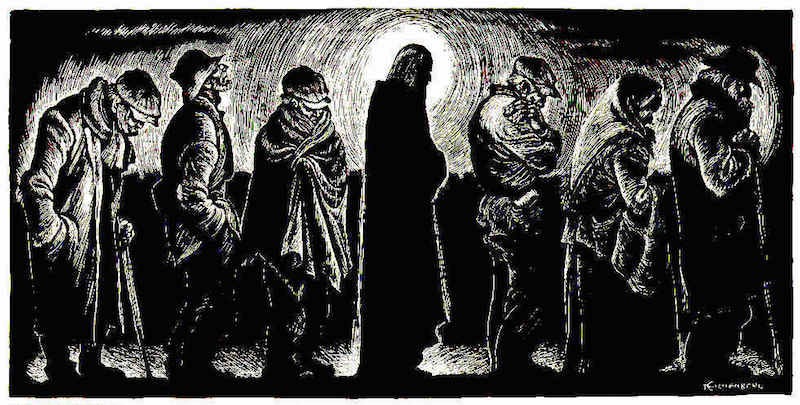
One of the speakers at Minimoot last year talked about this woodcut called Christ of the Breadlines and I’ve been thinking about it this week. I’m lucky enough to have a replica in my diningroom. It’s amazing to study the light.
🐦 I got some bird linocut artwork in November for my husband David’s birthday. It’s still being framed but I’m so excited to see how they turn out.
Thanks for reading, and for supporting this publication. As always, it really is a joy to write for people who read what I write, and to support my family during this crazy year.
—Steph
Lots of credit to Jemar Tisby for writing on issues of racism and injustice and for a great line that prompted my thinking on this- and please do check out his work on his substack, he’s an engaging educator and his most recent book is FULL of stories of hope from history of people who have gone before in making the world a better place, and he also leads group cohorts for people looking for community on this journey.
It is just amazing to me to see how this scene reveals so quickly the character of everyone in the group. The Witch sees she’s out of control immediately. Uncle Andrew wants to deny reality and cope with the chaos with alcohol. The Cabby can keep calm and carry on, and is concerned about the welfare of the children and the horse! Even if this is actually death he is calm and is going to deal with it using the same tools he’s used to deal with things all his life- a deep breath, a bit of common sense, and a hymn. The Uncle Andrew’s of the world are all quite eloquent and flashy, but would that we would all be the Cabby in a similar situation!
On the other hand, is there really ever an unsuitable hymn?
Thanks, Stephanie! Love what you are doing.
What a wonderful gift you gave me today....to put words to why I need to be with others. In our days, HOPE is a group project...and Jesus is the there in our midst!!
Cindy ONeill